
 how-to
IT Project ROI Calculation: A Practical Guide
Last Updated: October 23, 2026
Quick Summary
IT project ROI calculation measures the percentage return on a technology investment over a defined period: total benefits minus total costs, divided by total costs, multiplied by 100. Done properly, it makes you document every cost and every realistic benefit, so funding decisions rest on numbers rather than hope.
- Include all costs: hardware, software, implementation, internal staff time, training, support and a 10–15% contingency.
- Ramp benefits in realistically. Year one rarely delivers the full benefit.
- Track payback period and NPV alongside ROI, and test conservative, expected and optimistic scenarios.
- Compare against the true cost of doing nothing, which is never $0.
- Record unplanned benefits after go-live. They're often where the biggest value turns up.
All figures in AUD. Try the numbers yourself with our free ROI calculator and worksheet.
7 Common IT Project ROI Mistakes
- Counting the purchase price but not implementation, integration and training
- Leaving out internal staff time
- Assuming full benefits from day one
- Applying a percentage-point improvement to a cost, instead of the share of the problem removed
- Treating "do nothing" as free
- Using different time periods or definitions between projects
- Never measuring actual results after go-live
Table of Contents
- Why IT Project ROI Calculation Matters
- The ROI Formula for IT Projects
- TCO vs ROI: What's the Difference?
- Identifying and Quantifying Project Costs
- Estimating Financial Benefits
- Worked IT Project ROI Examples
- Payback Period and NPV
- Testing Your Assumptions
- When ROI Isn't the Deciding Factor
- Tax, Depreciation and GST in Australia
- ROI Calculator and Worksheet
- Measuring ROI After Implementation
- You Don't Know What You Don't Know
- Frequently Asked Questions
Why IT Project ROI Calculation Matters
When you're deciding whether to fund a new IT project, it comes down to three questions. Will it pay for itself? How long will that take? What happens if things don't go to plan?
IT projects make those questions hard to answer. Costs arrive upfront and keep coming, benefits build over time, and some outcomes are difficult to measure. If you're preparing the wider justification, see our guide on how to build a business case for an IT project.
Over more than 15 years deploying wireless, RFID and enterprise print solutions, I've seen plenty of technology investments that looked good on paper and fell apart in practice. Almost always, the problem was the assumptions, not the technology.
Pro Tip: Do your ROI calculation before you commit budget. It takes a few hours, saves you defending a bad decision later, and gives you a baseline to measure against once the project is live.
The ROI Formula for IT Projects
ROI is the percentage return on an investment over a specific period. Always state the period: a three-year and a five-year ROI for the same project can be very different numbers.
ROI = (Total Benefits − Total Costs) ÷ Total Costs × 100
- Total Benefits: cost savings, avoided costs, revenue gains and quantified intangibles over the period
- Total Costs: all upfront and ongoing costs over the same period
- Net Gain: Total Benefits − Total Costs
Simple example: you spend $100,000 on a system (including three years of support) and it delivers $150,000 in savings over those three years. Net gain is $50,000, so ROI = $50,000 ÷ $100,000 × 100 = 50%.
Key Takeaway: The formula is simple. The accuracy depends entirely on how well you've identified costs and estimated benefits.
TCO vs ROI: What's the Difference?
Total cost of ownership (TCO) is everything a solution costs over its life: purchase, implementation, support, energy, staff time and disposal. It answers "what will this really cost?"
ROI compares that cost against the benefits. It answers "is it worth it?"
Use TCO to compare options that do the same job (two vendors' mobile computers, say). Use ROI to decide whether to do the project at all. A good ROI calculation always starts with an accurate TCO, which is why the cost section below matters so much.
Identifying and Quantifying Project Costs
This is where most IT project ROI calculations go wrong. Teams count the obvious costs and miss the rest.
Initial investment and implementation costs
Start with what you're buying: hardware, software licences and consulting services. Then add implementation, which often costs more than the purchase price:
- Professional services to set up and configure the system
- Data migration from the old system
- Integration with the tools you already use
- Testing and validation before go-live
- Training so your team can use it properly
- Internal staff time: project management, subject-matter experts, user testing. Multiply the hours by a loaded hourly rate.
- Compliance and privacy obligations (for example, how tracking or location data is collected and stored)
- Insurance review (changes to cover or premiums)
- Contingency of 10–15% for costs you haven't anticipated
On large-scale RFID deployments I've worked on, hardware was only about 30% of the total implementation budget. The rest went to engineering, integration, testing and training.
Ongoing operating costs
After launch, the costs continue:
- Software maintenance and support contracts
- Hardware repairs, spares and eventual replacement
- Licence renewals
- Staff time for administration and troubleshooting
- Cloud hosting or data centre fees
A five-year calculation needs five years of operating costs, and you should check whether they rise each year. At the end of your period, also note whether the equipment still has useful life left. That remaining value is real, even though it isn't counted in the ROI.
Watch Out: Underestimating ongoing costs is the most common mistake. A system that looks profitable in year one can lose money by year three if support, upgrades and staff time weren't budgeted.
Estimating Financial Benefits
Cost savings, avoided costs and revenue gains
Cost savings are the easiest to quantify. If a new system means you need two fewer people in the warehouse, the saving is their salary and on-costs for each year they're not needed.
Avoided costs are the most often forgotten. Keeping the old system running has a price: support contracts, repairs, workarounds and the risk of failure. That money is a benefit of replacing it.
Revenue gains are trickier. If faster checkout increases throughput, you need to assume how many extra transactions you'll get, their average value, and what share would have happened anyway.
Other benefits to consider:
- Reduced error rates (fewer mis-picks, returns and refunds)
- Faster processing (fewer staff hours per transaction)
- Reduced shrinkage (better tracking and visibility)
- Lower energy costs
- Less downtime
Ramp benefits in realistically
Benefits don't arrive on go-live day. Staff are still learning, processes are still settling and the data is still being cleaned. A reasonable starting point is 50–70% of the full annual benefit in year one, then the full benefit from year two. Simple, user-facing upgrades like Wi-Fi ramp faster; process changes like RFID ramp slower.
Intangible benefits and how to quantify them
Some benefits don't show up as direct savings but still have financial value. If staff turnover drops from 25% to 18%, you've saved the cost of recruiting and training replacements. A more reliable wireless network means fewer outages, and an hour of downtime has a dollar value.
- Define the benefit, e.g. "fewer system outages"
- Find a financial proxy, e.g. "revenue lost per hour of downtime"
- Estimate the improvement, e.g. "outages fall from 4 per year to 1"
- Calculate the value: improvement × proxy
Keep intangibles conservative and list them separately from hard savings, so decision-makers can see how much of the case rests on each.
Worked IT Project ROI Examples
Example 1: RFID inventory tracking deployment
A mid-sized distribution centre is losing money to inventory inaccuracy: wrong items picked, phantom stock in the system, and hours of manual reconciliation. That's common. Research from the University of Arkansas RFID Research Center put average retail inventory accuracy at around 65% (Miles, Mitchell & Hardgrave, 2010). Auburn University's RFID Lab later found that RFID-verified shipments had order inaccuracies in less than 0.01% of orders, compared with 69% for legacy barcode data (Supply Chain Dive, 2018).

Assumptions:
- Inventory accuracy: 92% today, 99% target with RFID
- Current annual cost of inaccuracy: $180,000 (rework, refunds, lost sales)
- RFID system: $120,000 (hardware, software, implementation)
- Contingency: 15% ($18,000)
- Internal staff time: $10,000 (about 125 hours at $80/hour)
- Annual operating cost: $15,000
- Year 1 benefits at 60% while processes bed in
- Time horizon: 3 years
Estimating the benefit correctly: going from 92% to 99% closes 7 of the 8 points of error, which removes about 87.5% of the problem in theory. To stay conservative, we assume RFID removes 75% of the cost of inaccuracy: $180,000 × 0.75 = $135,000 a year at full benefit.
RFID deployment: three-year view
Year 1 | Year 2 | Year 3 | Total | |
|---|---|---|---|---|
Costs | $163,000 | $15,000 | $15,000 | $193,000 |
Benefits | $81,000 | $135,000 | $135,000 | $351,000 |
Net | −$82,000 | +$120,000 | +$120,000 | +$158,000 |
Year 1 costs: $120,000 system + $18,000 contingency + $10,000 internal time + $15,000 operating.
Three-year ROI: $158,000 ÷ $193,000 × 100 = 82% · Payback: about 20 months
Each realistic adjustment reduces the headline number, but the project still clears the bar comfortably:
How each adjustment changes the RFID result
Model | 3-year ROI | Payback |
|---|---|---|
Base (system + operating costs only) | 145% | 12 months |
+ 15% contingency | 121% | 14 months |
+ internal staff time | 110% | 15 months |
+ year 1 ramp-up (60%) | 82% | 20 months |
A common mistake in RFID business cases is applying the accuracy improvement (7 percentage points) to the cost, instead of the share of errors removed. That one slip turns a strong project into an apparent loss.
From the field: On a multi-site retail RFID rollout I worked on, the line items that grew most weren't the readers or the tags. They were [site surveys, cabling and mounting, and the time store teams needed to change how they counted stock]. Budget for the work around the hardware, not just the hardware.
Example 2: Enterprise Wi-Fi upgrade
An office building has dead spots in its meeting rooms. Video calls drop, file transfers stall, and staff can't rely on wireless.
Assumptions:
- Current system: 8 access points, more than five years old
- New system: 12 modern access points with cloud management
- Implementation: $45,000, plus 15% contingency ($6,750) and $3,000 of internal staff time
- Annual operating cost: $8,000 (support, cloud licensing)
- Current cost of Wi-Fi problems: $25,000 a year (lost productivity, troubleshooting, support calls)
- Expected reduction: 60%. New access points fix coverage and capacity, but some problems (client devices, internet service, applications) remain. That gives $15,000 a year, at 80% in year 1.
- Avoided cost: $4,000 a year for the old access points' support and repairs
- Time horizon: 5 years
Wi-Fi upgrade: five-year view
Year 1 | Years 2–5 (each) | 5-Year Total | |
|---|---|---|---|
Costs | $62,750 | $8,000 | $94,750 |
Benefits | $16,000 | $19,000 | $92,000 |
Net | −$46,750 | +$11,000 | −$2,750 |
Five-year ROI: −$2,750 ÷ $94,750 × 100 = −3%, which is effectively break-even.
Two things change the picture:
- The time horizon. Modern access points typically last longer than five years. Over seven years the ROI is +17%, with payback at about 63 months.
- The real alternative. The existing access points are past five years old. "Do nothing" eventually means an unplanned replacement after a failure, often at a worse time and price.
This is a marginal project financially, and that's a legitimate outcome. Leadership can still approve it, for lifecycle and risk reasons, as long as they know the return is modest. See When ROI isn't the deciding factor.
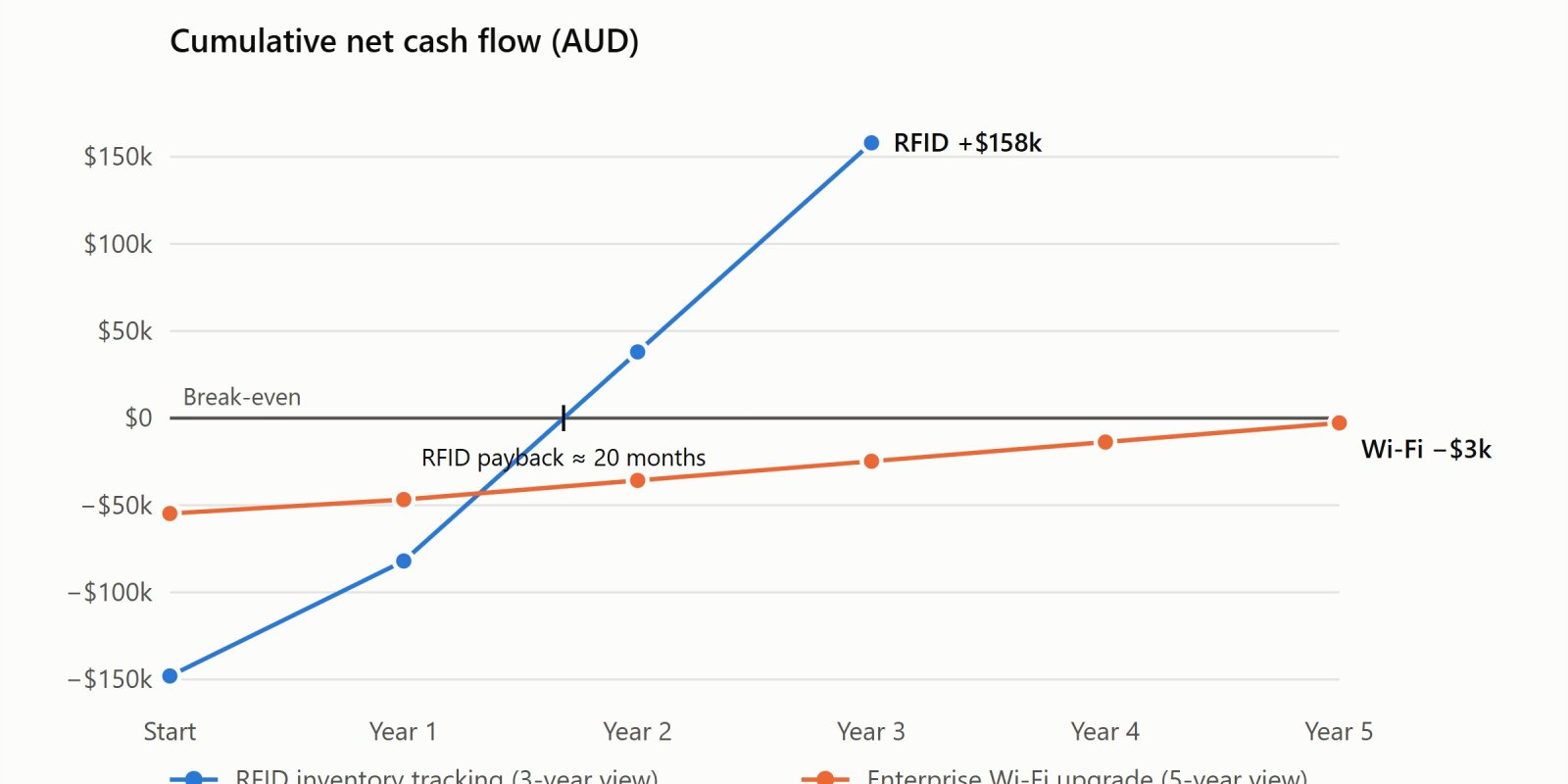
Cumulative net cash flow for both examples. RFID crosses break-even at about 20 months; Wi-Fi is still just below break-even at year 5.
Key Takeaway: Model the benefit correctly, include every cost, and compare against the true cost of doing nothing. RFID pays back in under two years even after conservative adjustments. Wi-Fi is close to break-even, and its case rests on lifecycle and risk. A negative ROI is a signal to check your baseline and your maths, not to go looking for extra intangibles to close the gap.
Payback Period and NPV
Payback period answers a different question: how long until this investment pays for itself? When the annual benefit is the same every year:
Payback = Upfront Investment ÷ Annual Net Benefit
When benefits ramp up, add the net cash flow year by year until the running total crosses zero (see the chart above). In the RFID example the running total is −$82,000 after year 1. Year 2 adds $120,000, so payback falls 82/120 of the way through year 2, at about 20 months.
Payback matters because it measures exposure. The longer an investment takes to pay back, the more exposed it is to obsolescence, restructures, sponsor changes and vendor pricing. Many organisations set a hurdle, such as payback under three years for discretionary IT spend.
Net present value (NPV)
ROI and payback treat a dollar in year three as worth the same as a dollar today. NPV corrects that by discounting future cash flows at your cost of capital or required return.
NPV = −Upfront Investment + Σ Net Cash Flowt ÷ (1 + r)t
For the RFID example at 8%, with a $148,000 upfront investment:
- Year 1: $66,000 ÷ 1.08 = $61,111
- Year 2: $120,000 ÷ 1.08² = $102,881
- Year 3: $120,000 ÷ 1.08³ = $95,260
- NPV = −$148,000 + $259,252 ≈ $111,000
A positive NPV means the project beats your required return. For the Wi-Fi example, NPV at 8% is about −$14,000 over five years and roughly zero over seven, which confirms it's marginal.
Testing Your Assumptions: Sensitivity Analysis
Every ROI depends on one or two key assumptions, so show decision-makers what happens if you're wrong. For RFID, the critical assumption is how much of the cost of inaccuracy is actually removed:
RFID example: three scenarios (all costs and ramp-up included)
Scenario | Cost removed | Full annual benefit | 3-year ROI | Payback |
|---|---|---|---|---|
Conservative | 50% | $90,000 | 21% | ~29 months |
Expected | 75% | $135,000 | 82% | ~20 months |
Optimistic | 87.5% | $157,500 | 112% | ~18 months |
Even the conservative case is positive and pays back within three years, which makes it much easier to approve. If a project only works in the optimistic scenario, treat that as a warning sign.
When ROI Isn't the Deciding Factor
Some projects should go ahead whatever the ROI says, and some with a great ROI should wait. Don't force an ROI calculation onto spend that is really about:
- Security and end of support: replacing an operating system or firmware that no longer gets security patches
- Compliance: meeting a regulatory, contractual or customer requirement
- Lifecycle risk: replacing hardware before it fails rather than after
- Strategic enablement: building a platform that other projects depend on
For these, compare the cost of the options (TCO) and the risk of not acting, and say clearly in the business case that it isn't an ROI decision. Leadership will trust your ROI numbers more if you don't stretch them to cover everything.
Tax, Depreciation and GST in Australia
How you pay for a project changes its cash-flow profile:
- Capital expenditure (buying hardware) is generally depreciated over the asset's effective life. Eligible small businesses may be able to use the instant asset write-off, and the thresholds and rules change.
- Operating expenditure (subscriptions, managed services, hardware-as-a-service) is generally deductible in the year it's incurred and spreads the cost evenly.
- GST: if you're registered for GST and can claim input tax credits, model costs excluding GST.
These don't change whether a project is a good idea, but they can change which funding model gives the best return. Check the treatment with your accountant.
ROI Calculator and Worksheet
Rather than doing this on the back of an envelope, use a structured worksheet. The discipline of filling in each section is what exposes weak assumptions.
Section | What to capture |
|---|---|
Project details | Name, dates, stakeholders, time horizon, discount rate, key assumptions |
Costs | Hardware, software, implementation, internal staff time, contingency, annual operating costs by year |
Benefits | Cost savings, avoided costs, revenue gains, intangibles (with proxy), year 1 ramp-up |
Results | Net gain by year, cumulative cash flow, ROI, payback (months), NPV |
Scenarios | Conservative, expected and optimistic |
Benefits register | Forecast vs actual, plus unplanned benefits found after go-live |
Free tools: Try the IT Project ROI Calculator to test your numbers in your browser, or download the Excel ROI worksheet with costs, benefits, scenarios and a benefits register built in.
Measuring ROI After Implementation
This is the part most teams skip. Plan it before launch: which metrics, how often, and who collects them.
RFID example: inventory accuracy (monthly), cost of inaccuracy (rework hours, refunds, lost sales), system uptime and support costs, and adoption rate.
Wi-Fi example: connectivity help-desk tickets, staff survey scores, meeting room usage, and IT time spent on wireless troubleshooting.
Compare actuals to forecast and record why they differ. That record is what makes your next business case more accurate.
Watch Out: Don't measure too early. Most IT projects need 6–12 months before benefits are fully realised. Measure too soon and a project that's still ramping up looks like a failure.
You Don't Know What You Don't Know: Capturing Unplanned Benefits
New or upgraded technology almost always delivers benefits nobody put in the business case. Once people have better data, better connectivity or better tools, they find uses for them that weren't possible before, and nobody could have forecast them.
A good example is a hospital that deploys RFID-based real-time location (RTLS) for two planned reasons: to understand how patients and staff move through the building, and to know where life-saving equipment such as defibrillators and infusion pumps is at any moment. Both benefits are in the business case and both can be measured.
Once the system is live, a benefit nobody planned for appears. The hospital now knows where the equipment is and where the people are, so it can work out the fastest route to get that equipment to a patient, steering around crowded corridors and congested lifts. In a medical emergency, minutes matter. That benefit wasn't in the forecast and couldn't have been, but it may be the most valuable thing the system does.
Then the benefits start to compound. Once the hospital has months of movement history, it can move from reacting to predicting:
- Predicting traffic flow: patterns show where people are likely to go next, such as shift changes, visiting hours, theatre turnarounds and admission surges from the emergency department. Facilities and operations teams can stagger movements, direct lift use, and plan porter and transfer routes before corridors become congested, not after.
- Placing equipment where it's needed: live and historical data show where life-saving devices are actually used and how long it takes to reach them. Defibrillators, crash carts and pumps can then be positioned, or moved through the day, so they're easier to get to from where demand is highest. Gaps in coverage show up before an emergency exposes them.
None of this was in the original business case. Each new use is built on the same infrastructure and the same data, so it adds value at almost no extra cost. That's why unplanned benefits often end up worth more than the planned ones, and why they deserve a formal place in your reviews.
Other examples:
- RFID deployed for inventory accuracy turns out to speed up click-and-collect, cut store replenishment time, and show where loss happens, giving loss-prevention teams evidence they never had.
- A Wi-Fi upgrade deployed for meeting rooms gives you occupancy and space-utilisation data that informs a property decision, and a platform for IoT sensors.
- A printer fleet refresh brings remote monitoring that flags faults before they stop a line, and data that shows which sites are over-provisioned.
Why unplanned benefits matter
- Reviews: post-implementation reviews that only check the original forecast undersell the project. Documented extra value shows the true return.
- Future business cases: unplanned benefits from one project become planned, evidence-backed benefits in the next.
- Credibility: a track record of honest forecasts plus documented extra value is the strongest argument you can take to leadership.
How to capture them
- Add an "unplanned benefits" section to your benefits register from day one, so there's an obvious place to record them.
- Ask the users at 3, 6 and 12 months: "What can you do now that you couldn't before?" Operations staff often find the value first.
- Record each one properly: date, description, who found it, estimated annual value (with the proxy you used) and the evidence.
- Report them separately in post-implementation reviews, alongside, not mixed into, forecast vs actual.
Don't bank on them: unplanned benefits belong in your reviews, not your forecast. If a project only works because of benefits you hope to find later, it doesn't work yet. Approve on the known benefits and treat the rest as upside.
At Inverse Networks, we've helped teams through this whole cycle: honest ROI upfront, careful measurement afterwards, and a record of the value nobody expected. If you're scoping an RFID, wireless or mobility project and want a second set of eyes on the numbers, talk to Inverse Networks. We'll help you build a business case that stands up to finance. We also provide managed IT services to keep the benefits flowing after go-live.
Frequently Asked Questions
How do you calculate ROI for an IT project?
ROI = (Total Benefits − Total Costs) ÷ Total Costs × 100, over a defined period, including upfront and ongoing costs. In our RFID example, three-year costs of $193,000 (system, contingency, internal time and operating costs) against benefits of $351,000 give a net gain of $158,000 and an ROI of 82%.
What costs should be included in an IT project ROI calculation?
Hardware, software, implementation, integration, testing, training, internal staff time and a 10–15% contingency upfront, plus licensing, maintenance, support and administration every year. In my years at Zebra working on enterprise deployments, ongoing support was the cost teams most often underestimated, and it had a big effect on long-term ROI.
What is the difference between TCO and ROI?
TCO (total cost of ownership) is the full lifetime cost of a solution. ROI compares that cost against the benefits. Use TCO to compare options that do the same job, and ROI to decide whether the project is worth doing.
What is project payback period and why does it matter?
Payback period is how long it takes cumulative net benefits to recover the upfront investment. A $100,000 project returning $30,000 a year in net savings pays back in about 3.3 years. Shorter payback means faster value and less exposure to obsolescence or business change.
How do you measure intangible benefits in an IT project?
Use a measurable financial proxy. If better Wi-Fi cuts support tickets by 20%, value the support labour saved. If RFID reduces mis-picks, value each error prevented at the cost of the refund or lost sale. Keep intangibles conservative and separate from hard savings.
Should unplanned benefits be included in an IT project's ROI?
Not in the forecast. Approve projects on known benefits. After go-live, record unplanned benefits in a benefits register and report them in post-implementation reviews. They show the project's true value and give you evidence for future business cases.
What is a good ROI for an IT project?
There's no universal benchmark, but a project should beat your organisation's cost of capital, and many businesses look for payback under three years on discretionary IT spend. A positive ROI under conservative assumptions is stronger than a high ROI that only works in the optimistic case.