 how-to
Rolling Out RFID at Scale: Lessons from a Two-Year Retail & Warehouse RFID Program
Rolling Out RFID at Scale: Lessons from a Two-Year Retail RFID Program
Table of Contents
- Deploying Zebra RFD40s Across Two Countries and Multiple Brands
- The Scale of the Challenge
- Testing Methodologies and Spectrum Analysis Baselines
- Extending into RTLS with Zebra MotionWorks Enterprise
- Early Mornings, Late Nights and the Guaranteed Curve Ball
- What I Took from It
- Planning an RFID or RTLS Rollout?
- Frequently Asked Questions
I spent close to two years working on RFID projects for one of Australia's largest retailers. It started as a hardware rollout and ended up touching almost every part of how a large retailer thinks about inventory accuracy, store operations and asset visibility. Here's what we were engaged to do, what we delivered, and what I took away from it.
Key takeaways
- Zebra RFD40 RFID handhelds deployed across hundreds of stores, two countries and multiple brands.
- Tag encoding and printing cut from 4–6 seconds per tag to 1–1.5 seconds, saving roughly 8 months of labour.
- Repeatable Wi-Fi and spectrum analysis baselines gave the business a benchmark for future RFID work.
- An RTLS trial with Zebra MotionWorks Enterprise and fixed ATR7000 readers moved visibility from point-in-time to real-time and context aware.
- Inclusion and a steady cadence with the business mattered as much to success as the technology.
Deploying Zebra RFD40s Across Two Countries and Multiple Brands
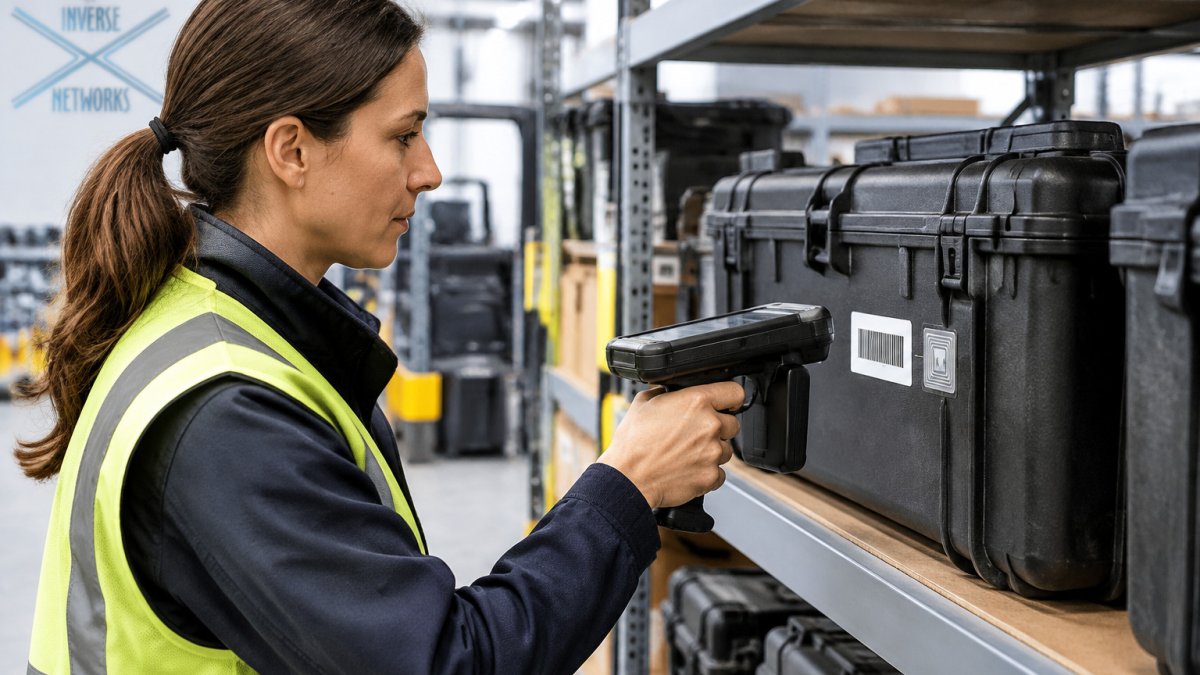
The core of the project was rolling out Zebra RFD40 RFID handhelds across retail stores. On paper that sounds simple: unbox the devices and turn them on. At this scale, it's anything but.
We were responsible for the hardware deployment itself and for advising on how the rollout should happen store by store: sequencing, configuration, provisioning, and making sure store teams could pick the devices up and use them without a steep learning curve.
More than a hardware rollout
The project meant supporting people at every level of the business:
- Shop floor staff and store managers learning a new way of working
- Business analysts and stakeholders across multiple divisions who needed the data, workflows and processes to line up
- Developers getting to grips with new concepts, such as radio control parameters for custom applications
- Work health and safety teams assessing device suitability for different employee profiles
Coordinating all of that, plus external partners on the hardware and integration side, was as much a part of the job as the physical deployment.
The Scale of the Challenge
For one of Australia's largest retailers, introducing RFID as a parallel process alongside barcodes, and ultimately working towards it as a replacement, is a huge undertaking. Thousands of team members had to learn a new technology, and being part of that team as we worked towards user acceptance was rewarding.
Projects at this scale don't come around often. We were looking at hundreds of stores across Australia, with RFID tagging happening in several phases: source tagging by suppliers, and tagging of existing stock in store. That left a huge amount of work to get through, and one question to answer: how do you tag 50,000 items per store without dragging out the parallel-process period longer than it needs to be?
Cutting tag encoding time by up to 75%
Every third-party solution on the table estimated 4–6 seconds to encode and print each tag. At that volume, the labour forecast was enormous.
Inverse Networks proposed, helped develop and ultimately deployed an internal solution that brought manual tag encoding and printing down to 1–1.5 seconds per tag. At a project of this scale, that's roughly an 8-month saving in labour.
Testing Methodologies and Spectrum Analysis Baselines
One of the most valuable outcomes of the program was building proper testing methodologies, rather than treating RFID as a one-off project. We ran Wi-Fi data captures and spectrum analysis baselines in multiple locations to understand RF conditions on site, and used them to set repeatable benchmarks that future RFID initiatives could be measured against.
This matters because RFID performance depends heavily on the environment. Read rates, tag placement, interference, location layout and RF noise all affect results differently from site to site. With a consistent way to test and benchmark, we weren't reinventing the approach every time a new store, category or use case came up, we gave the business a reference point.
Extending into RTLS with Zebra MotionWorks Enterprise
Beyond the handheld rollout, we deployed a Real-Time Location System (RTLS) using Zebra's MotionWorks Enterprise platform. This involved installing fixed Zebra ATR7000 RFID readers, taking the capability beyond point-in-time scanning with handhelds to continuous, context-aware, location-based visibility.
Fixed infrastructure is a different beast to a handheld deployment. Reader placement, coverage zones, and interference from store fixtures and stock all need to be worked through properly before you can trust the data coming out the other end. Running this as a testing phase let us validate the approach before planning a wider rollout.
Early Mornings, Late Nights and the Guaranteed Curve Ball
Projects like this don't run nine to five. Early mornings and late nights became the norm: 6am in-store testing and 11pm pre-production rollouts tested even the most resilient of us.
The curve balls kept coming, too. Partway through the deployment, a batch of different RFID tags arrived and stopped our tagging process cold. I found out at 6pm on a Friday, two hours into a drive down the south coast for what should have been a weekend getaway, when the panic calls started. We had a fix in place by the next business day.
At this scale, something will always come at you sideways. Having a team that can absorb it and keep moving matters as much as any plan.
What I Took from It
Every business wants "runs on the board" when introducing new technology, and this customer was no different. Establishing clear ROI through agreed KPIs, in areas of the business where the impact is tangible to everyone involved, is how you build and keep momentum.
Looking back on this deployment, and on the many other businesses I've helped introduce RFID across Australia, every one is different. There's rarely one correct way to do it. There might be several ways that are 99% right, or none at all.
What matters most when RFID touches multiple parts of a business is inclusion. In practice, that meant:
- Bringing business units in early, from the first introduction through concept acceptance and testing, rather than handing them a finished solution
- Location champions who learned the devices first and became the go-to person for their team
- Pilot locations that shaped the rollout, with their feedback changing processes before they reached every location
- Sharing the wins, so teams saw the accuracy gains and time savings their effort was creating
- Keeping the cadence going after go-live, not just until sign-off
Your team is your best asset. They need to be on board and motivated, especially when they’re the ones talking to customers who may be going through a change of their own.
There's no other way to put it: this was a massive team effort, possibly one of the biggest RFID programs ever run across Australia and New Zealand, and I'm grateful to have been part of it.
Planning an RFID or RTLS Rollout?
If you're planning an RFID or RTLS rollout and want to talk through what worked, and what I'd do differently, I'm always happy to have that conversation. Get in touch with Inverse Networks.
Frequently Asked Questions
How long does it take to tag stock for a retail RFID rollout?
It depends on the encoding method. Typical third-party solutions take 4–6 seconds to encode and print each tag. On this program, an optimised internal process reduced that to 1–1.5 seconds per tag, which at roughly 50,000 items per store saved around 8 months of labour across the rollout.
What is the difference between handheld RFID and RTLS?
Handheld RFID readers such as the Zebra RFD40 capture inventory at a point in time, when someone scans. A Real-Time Location System (RTLS) uses fixed readers, such as the Zebra ATR7000, to give continuous, location-based visibility of tagged items without manual scanning.
Why do RFID deployments need spectrum analysis and testing baselines?
RFID performance varies from site to site because of store layout, fixtures, stock, tag placement and RF noise. Spectrum analysis and repeatable test baselines show the RF conditions in each store and give the business a benchmark for measuring future RFID initiatives.
What is the biggest factor in a successful RFID rollout?
Inclusion. Bring business units in early, from introduction through concept acceptance and testing, rather than handing them a finished solution. Store champions, pilot stores whose feedback shapes the rollout, and sharing wins with store teams all help, as does keeping that cadence going after go-live. Teams that feel involved adopt faster, and that matters as much as the technology itself.